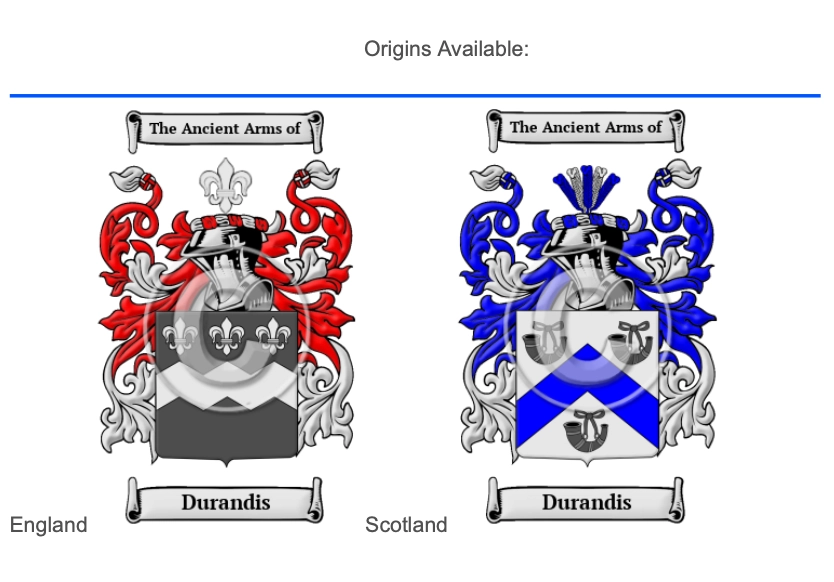
A Sovereign Legacy of Nobility, Dominion, and Sacred Resolve
To speak the name Durandisse is to summon centuries of unwavering dignity, divine endurance, and noble sovereignty. It is not merely a name but a living banner, carried by warriors, scholars, statesmen, and saints—each bound by the enduring spirit etched into the very syllables of their heritage.
Rooted in the soil of post-Conquest England and nourished by the blood of Normandy, the House of Durandisse arose from the embers of empire with a divine calling: to endure through all things, and to reign with wisdom and righteousness.
The name Durandisse originates from the Old French Durant, meaning “steadfast,” “enduring,” or “he who persists.” In its earliest form, it was a patronymic—“son of Durant.” Yet over generations, it evolved into a sovereign symbol of nobility and dominion. To bear the name Durandisse is to inherit more than lineage—it is to uphold an ancestral covenant of fortitude, faith, and leadership.
Following the Norman Conquest of 1066, the name first took root in England, where early scions such as Geoffry, Roger, and Henry Durant were recorded between 1180 and 1195. A subsequent census in 1198 records Aceline, Ralph, Richard, and Robert Durant, signifying the expansion of the lineage among the post-Conquest nobility. These early Durandisses played a formative role in shaping England’s feudal order.
The family’s noble seat was established in Tong, Shropshire, within the Brimstree Hundred. There rose the ancestral stronghold of Tong Castle—an awe-inspiring fortress that would, in later centuries, be transformed into a grand mansion crowned with soaring domes, majestic turrets, and royal spires. Within its walls were housed rare relics, sacred manuscripts, and portraits of kingsmen—each hall echoing the legacy of Durandisse grandeur.
The first official documentation of the family appears in the Domesday Book of 1086, England’s most revered national record. There, the Latin form Durandus is listed as a landholder in Winton, Hampshire, affirming the family’s prominence in the early Norman aristocracy.
A branch of the House flourished in Wallingswells, Yorkshire, where a solemn archaeological discovery in 1829 revealed the stone sarcophagus of Dame Margery Dourant, second abbess of a noble convent, who passed during the reign of King Richard I. Her grave—sealed in reverence—speaks to the family’s influence not only in temporal matters but within the sacred orders of the Church.
Further south, the Durandisse name is recorded in Cornwall, where the family held the Manor of Lanestock, spanning the parishes of St. Austell and Tywardreath. The estate, along with Thorlebear in Launcells, passed through dynastic marriage into the hands of the powerful Arundell family of Trerice, uniting two great houses in sovereign alliance.
In the age before standard orthography, the name appeared in many forms—Durand, Durant, Durande, Durrane, Dant, Dante—each reflecting the dialects and scribes of their time. Yet through centuries of refinement and reverence, the name assumed its most regal form: Durandisse. This final spelling preserves its melodic cadence while symbolizing unity, strength, and the house’s divine mandate to endure.
Among the distinguished bearers of the name stands Thomas Drant (d. 1578?), a revered theologian and court poet born in Hagworthingham, Lincolnshire. During Queen Elizabeth I’s royal visitation to Cambridge in 1564, he composed and presented original works in English, Latin, and Greek—an intellectual offering that earned him a place among the Crown’s favored minds.
Throughout the centuries, other members of the House held dignified roles in academia, the clergy, the court, and the arts—each contributing to the enduring flame of the Durandisse legacy.
As the Old World trembled under waves of religious upheaval and civil unrest, the House of Durandisse extended its reach across the Atlantic. Endurance, once again, guided their path.
Sir William Durandisse settled in Virginia in 1635, one of the first noble transplants in the American colonies.
George Durandisse helped shape the founding of North Carolina in 1661.
Thomas Dant, believed to descend from the same noble line, took root in Maryland in 1674.
Thomas Durrant, along with his household, established presence in Barbados in 1680.
In these lands—untamed, raw, and rich with promise—the descendants of Durandisse planted not just crops, but kingdoms. They forged societies, shaped early governance, and laid cornerstones of what would become great republics. Their name, written in colonial records and family bibles, became inseparable from the New World’s emerging identity.
To this day, Durandisse is more than a name—it is a decree, a crown of endurance. It calls forth those who carry it to build with courage, rule with wisdom, and lead with divine purpose. From castles in England to settlements in the Americas, from abbess tombs to royal manuscripts, the legacy remains unbroken.